Humboldt Women's March Fills Courthouse Steps
Hundreds gathered on the Humboldt County Courthouse steps Sunday for an International Women's Day rally featuring the Raging Grannies, local speakers, and more homemade signs than anyone could count.
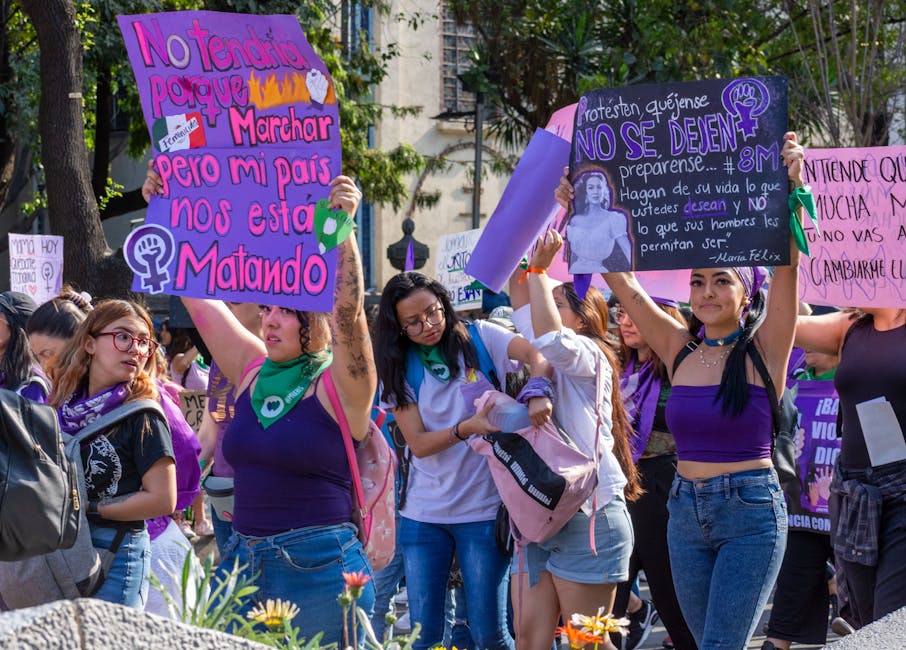
The fog lifted just in time. By 10 a.m. Sunday, the Humboldt County Courthouse steps were covered in hand-painted signs, pink hats that have seen better days, and at least one golden retriever wearing a bandana that read “Good Girl Energy.” The crowd, estimated by organizers at around 350 people, spilled onto the sidewalk along Fourth Street and into the small park across from the courthouse entrance.
It smelled like coffee and damp wool. Someone had set up a folding table with thermoses of hot cocoa near the corner, free for anyone who wanted some. Most people did.
The Humboldt County chapter of the National Women’s March organized the rally to coincide with International Women’s Day. This was the ninth consecutive year the group has held a local event, though the size has fluctuated. Organizer Beth Matsumoto said this year’s turnout was the largest since 2020.
“People are angry again,” Matsumoto said, adjusting a bullhorn strap on her shoulder. “Or maybe they never stopped being angry and just got tired. But something’s different this year. I can feel it.”
The Raging Grannies
The Raging Grannies of Humboldt Bay opened the rally at 10:30 with three songs, including their signature rewrite of “This Land Is Your Land” that swaps in lyrics about healthcare access and equal pay. They wore their usual uniform of oversized hats, floral dresses, and reading glasses perched on noses. The youngest member of the group is 62. The oldest is 84.
They’ve been performing at local rallies and protests since 2003. Their harmonies are imperfect and their timing occasionally drifts, which is entirely the point. The crowd sang along to the parts they knew and clapped through the parts they didn’t.
“We don’t do this because we think we’re good singers,” said Granny member Patricia Emerson afterward, laughing. “We do it because nothing makes a politician more uncomfortable than a bunch of old ladies with a sense of humor and nowhere else to be.”
Speakers
Five local women spoke from a makeshift podium, a wooden lectern borrowed from the Unitarian church down the street.
Dr. Rosa Gutierrez, an OB-GYN at St. Joseph Hospital, talked about the impact of state-level policy shifts on reproductive healthcare in rural communities. She didn’t get into specific legislation, but her point was clear: access in Humboldt County depends on a small number of providers, and any disruption to funding or legal protections ripples fast in a place this remote.
“In a city, you lose one clinic and there are five others within driving distance,” Gutierrez said. “Here, you lose one provider and that’s it. People drive to Redding. People drive to Santa Rosa. Some people just don’t go.”
Mariana Esperanza, a cannabis cultivator and single mother from the Mattole Valley, spoke about the intersection of economic survival and gender in Humboldt’s cannabis industry. She described being one of only a handful of women who hold cultivation licenses in her area.
“The guys at the co-op meetings, they’re nice, they really are,” she said. “But there’s still this assumption that I’m someone’s wife or someone’s bookkeeper. I’m neither. I run my own farm and I’m pretty good at it, actually.”
The crowd cheered.
Other speakers included a Eureka High School junior who talked about online harassment, a Wiyot Tribal Council member who spoke about missing and murdered Indigenous women, and a retired teacher from Arcata who delivered a five-minute speech entirely about the history of women’s suffrage in Humboldt County that managed to be both deeply researched and genuinely funny.
The march
After the speeches, the group walked a loop from the courthouse down Fourth Street to F Street, up to Fifth, and back. It took about 25 minutes. A few cars honked in support. One honked in what appeared to be annoyance, though it’s hard to tell sometimes.
Signs ranged from the political (“Bodily Autonomy Is Not Negotiable”) to the personal (“My Grandma Marched So I Wouldn’t Have To, But Here I Am”) to the delightfully absurd (“Women Belong in All Places Where Decisions Are Being Made, Including the Dispensary”).
By noon, the crowd had thinned and the hot cocoa was gone. Matsumoto and a handful of volunteers stayed to pick up stray flyers and break down the sound system, a single speaker and a car battery that had served its purpose admirably.
“Same time next year,” Matsumoto said, folding a banner. “Unless we don’t have to. But we probably will.”